What are Archetypes and Why Do We Work With Them?
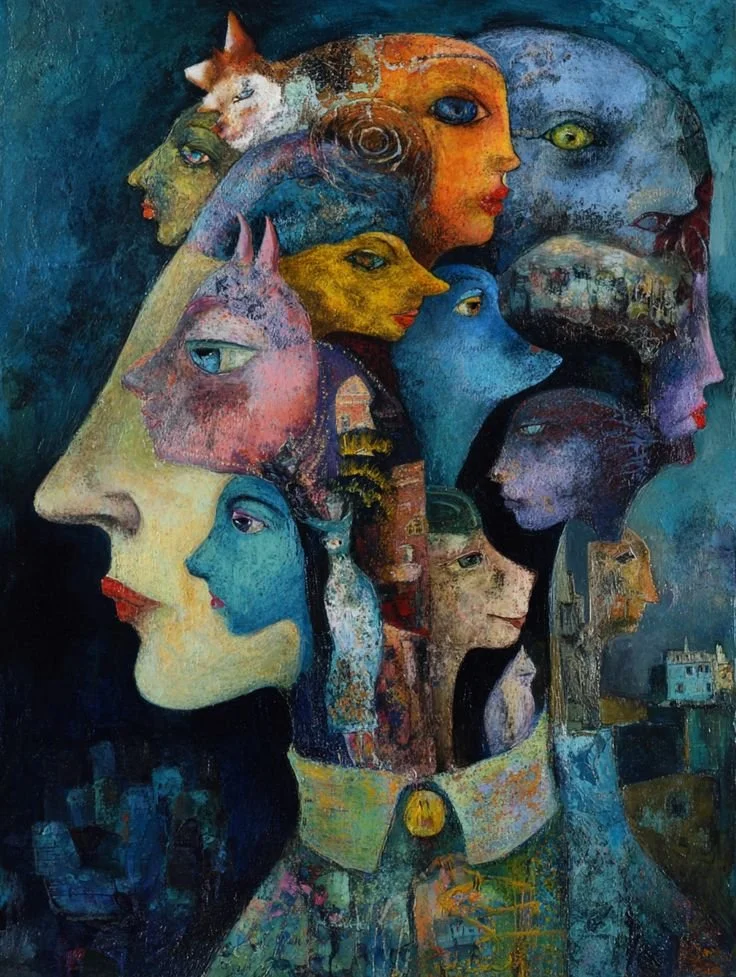
What Are Archetypes?
The word archetype comes from the Greek arche (original, first) and typos (pattern, imprint). Literally: the original pattern. An archetype is a primordial image, character, or theme that recurs across all human cultures, throughout all of history, because it emerges not from any one person's imagination but from the deep structure of the human psyche itself.
The concept was brought into modern psychology most fully by Carl Gustav Jung, who proposed that beneath the personal unconscious (the layer of repressed memories and individual experiences) lies a deeper stratum he called the collective unconscious. This is a layer of psychic material shared by all human beings, not inherited through culture or learning, but carried in the very architecture of our minds. Archetypes are the organizing patterns within that collective unconscious. They are not images themselves but the tendency to produce certain kinds of images, stories, and experiences, universally.
This is why a child raised in Tokyo and a child raised in rural Brazil, with no cultural contact, will both independently dream of a Great Mother, a Wise Old Man, a Shadow figure, a Hero, a Trickster. These are not learned. They are structured into human consciousness the way grammar is structured into the capacity for language.
Where Do We Find Them?
Archetypes appear everywhere humans have made meaning:
In myth and religion. Every culture has a dying-and-rising god (Osiris, Dionysus, Christ, Inanna). Every culture has a Great Mother, a Trickster who disrupts order to create something new, a Hero who undergoes trials and returns transformed. These are not coincidences of culture borrowing from culture. They are the same deep patterns expressing themselves through different costumes.
In fairy tales and folklore. Bruno Bettelheim, in The Uses of Enchantment, showed how fairy tales speak directly to the archetypal psyche of children, encoding wisdom about fear, desire, shadow, and transformation in symbolic form.
In literature and film. Every story that grips us does so because it activates an archetypal pattern. The mentor who must die so the student can grow (Gandalf, Obi-Wan). The descent into darkness before the return (Orpheus, the hero's journey). The shadow twin who represents the protagonist's unlived life.
In dreams. Jung's greatest laboratory was the dream. Archetypal figures appear in dreams often with a numinous, larger-than-life quality: the terrifying witch, the luminous stranger, the ancient wise woman, the child who is somehow not quite human. These figures arrive with emotional charge precisely because they carry collective energy, not just personal memory.
In the psyche itself. Jung identified a number of key archetypes within the individual: the Persona (the mask we wear in public), the Shadow (everything we have rejected or denied in ourselves), the Anima/Animus (the inner feminine in men, the inner masculine in women), and the Self (the organizing center of the whole psyche, the archetype of wholeness).
Major Archetypes and What They Carry
While archetypes are theoretically unlimited, certain ones appear with particular frequency and power:
The Hero carries the energy of courage, initiation, and the willingness to face trials for the sake of growth or community. The danger of the Hero is inflation: the ego that identifies too completely with the Hero becomes the tyrant, the one who cannot admit defeat or vulnerability.
The Shadow is everything the ego has disowned: the rage, the sexuality, the greed, the grief, the power that didn't fit the family or culture's requirements. The Shadow is not evil; it is unlived life. Unexamined, it operates as projection, we see in others what we cannot see in ourselves. Integrated, it becomes tremendous energy and creativity.
The Great Mother holds the polarities of nourishment and devouring, creation and destruction. She appears as the loving mother, the terrible mother, the earth goddess, the witch, the queen. She governs fertility, death, transformation, and the cycles of time.
The Wise Old Man/Woman carries the archetype of meaning, wisdom, and the connection to deeper truth. They appear in dreams and stories as guides, mentors, elders who hold knowledge the hero cannot yet access alone.
The Trickster (Coyote, Loki, Hermes, Anansi) disrupts fixed order, breaks rules, and in doing so, creates the space for something new to emerge. The Trickster is the archetype of creative chaos, necessary to every living system.
The Child archetype holds both vulnerability and radical potential, the future, the innocent, the one who sees the emperor's new clothes. It is connected to the divine child in religious traditions: the miraculous birth, the child who transforms the world.
The Self is perhaps Jung's most important contribution: the archetype of totality, the image of wholeness that the psyche is always moving toward. It appears symbolically as a mandala, a circle, a king and queen together, a divine marriage. The Self is not the ego; it is larger than the ego and holds all the opposites.
We also live with and engage with archetypes everyday within our family dynamics. Think about it, Mother, Father, Wife, Mother, Husband, Father, Child. These are all archetypal templates.
Why Do We Work With Archetypes?
This is perhaps the most important question. There are several compelling reasons.
Because they are already working with us. Archetypes don't wait for an invitation. They operate in the unconscious whether we are aware of them or not. When someone is gripped by an inexplicable depression, caught in a repeating life pattern, drawn compulsively toward a certain kind of person or situation, often an archetypal dynamic is at work beneath the surface. “Making the unconscious conscious”, as Jung put it, is the difference between being lived by these forces and learning to live with them intentionally.
Because they are the language of the deep psyche. The unconscious does not speak in rational propositions. It speaks in images, symbols, stories, myths, and figures. Archetypal work gives us a vocabulary for that language, so we can begin to understand what our dreams, our symptoms, our creative impulses, our relationships are actually trying to say.
Because integration heals. Much psychological suffering is, at its core, a problem of split-off energy. The parts of ourselves we have rejected, the Shadow, the unlived life, the emotion that was never allowed, do not disappear. They accumulate. They erupt. They sabotage. Archetypal work, whether through dreamwork, active imagination, creative expression, or somatic practice, creates a pathway for those energies to be met, understood, and integrated. This is not merely intellectual. It is a genuine transformation of the personality.
Because they connect us to something larger than the personal. One of the most striking effects of genuine archetypal encounter is the feeling of being in contact with something transpersonal, something that is not just your story but the human story. This is, as Jung understood, the closest secular psychology comes to what religious traditions call the sacred. It gives suffering meaning. It situates the individual life within a larger pattern. It reconnects the isolated modern self to the community of all humans who have ever lived, who have dreamed the same dreams, faced the same thresholds, been called by the same deep forces. (For me, this is one of the most compelling reasons to work with archetypes. Why are we drawn to study the Divine Feminine? Because it brings us into contact with a fractal of our own being and elevates it.
Because they are the grammar of story. For writers, artists, teachers, and culture-makers, understanding archetypes is understanding why some stories die and some stories live forever. It is understanding what the human soul actually hungers for, not entertainment, but recognition. The deep yes of encountering a story that reflects something true about what it means to be alive.
Because we are living in an archetypal moment. At a collective level, we are in what many mythologists and depth psychologists would recognize as a time of the death of one world and the as-yet-unclear birth of another. Times of threshold, of crisis and transformation, are precisely when the archetypes become most active and most visible. The polarization, the apocalyptic imagery, the search for heroes and the identification of villains, the return of suppressed traditions: all of this is archetypal material erupting into collective life. Understanding it as such does not make it less urgent. But it gives us a way to navigate it with more wisdom, more creativity, and more soul.
Archetypes and Astrology - The Relationship
Astrology and archetypes are, at their root, the same system speaking two different languages. The planets and signs of the astrological tradition are not astronomical facts so much as they are archetypal fields, each one encoding a distinct quality of human experience and consciousness.
Mars is not merely a red planet; it is the archetypal principle of will, aggression, desire, and the drive to act. Venus is not merely a bright point of light; it is the principle of beauty, relatedness, value, and eros. Saturn carries the archetype of limitation, discipline, time, and the stern teacher who strips away illusion.
Jung himself recognized this correspondence deeply, studying astrology seriously and writing that astrological indicators coincided with psychological complexes in ways that fascinated him. The twelve signs similarly map onto archetypal modes of being: Scorpio as the archetype of depth, death, and transformation; Sagittarius as the eternal seeker and philosopher; Capricorn as the one who must build, endure, and master the material world. When an astrologer reads a birth chart, they are essentially mapping which archetypal energies are most powerfully constellated in a person's psyche and life, which ones are in tension, which ones are seeking integration.
What makes this relationship so compelling, and so useful, is that astrology gives archetypes a dynamic, living framework. It tracks them not as static categories but as forces that move through time, that intensify, recede, conflict, and cooperate.
A Saturn return is not just a astrological event; it is an encounter with the archetype of necessity and maturation, arriving on schedule whether the person is ready or not. A Venus-Pluto transit is an activation of the eros-and-underworld archetypal complex, pulling love and power and shadow into the foreground of experience.
The mythologist Richard Tarnas, in his landmark work Cosmos and Psyche, spent decades demonstrating that major historical and cultural shifts correlate with the angular relationships between outer planets, as if the archetypal field itself has a rhythm, a breathing in and out of certain qualities of consciousness. Seen this way, astrology is not fortune-telling. It is a living symbolic system for tracking the movement of archetypal energies through time, both in the individual life and in the life of the collective, offering not prediction but a deepened quality of attention to what is actually at work beneath the surface of events.
Archetypal Possession
There can be a shadow side of working with Archetypes that we feel is important to mention here.
Archetypal possession, as explored by Paul Levy, is what happens when an archetype stops being something a person relates to and instead becomes something that takes over. In Jungian psychology, the healthy relationship to an archetype involves a degree of separation: the ego is influenced by the archetypal energy, moved by it, even inspired by it, but retains enough awareness to know that the archetype is not the whole of who it is.
Possession collapses that distance. The person becomes, in effect, a vessel through which the archetype operates without filter, without reflection, without the moderating influence of individual consciousness. Levy draws heavily on Jung's concept of inflation, the state in which the ego has been swallowed by an archetypal content and now unconsciously identifies with it rather than carrying it consciously. A man possessed by the Hero archetype does not simply act heroically in appropriate moments; he compulsively casts every situation as a battle, cannot admit weakness, and will destroy relationships and institutions in service of a crusade that feels, to him, absolutely righteous and cosmically ordained. He is not choosing the Hero. The Hero is choosing him.
What makes Levy's work particularly urgent is his application of this concept to the collective level, to what Jung called the psychic epidemic. Levy, drawing on his own experience of being labeled psychotic and his years of study with Tibetan Buddhist teachers as well as deep immersion in Jung, argues that entire cultures and nations can fall under archetypal possession, and that this is precisely what we are witnessing in the modern world. When a political movement, a nation, or an ideology becomes gripped by an archetype, the shadow of that archetype, its dark, unchecked, unconscious face, gets projected outward onto an enemy, a scapegoat, an Other who must be destroyed. The possessed collective cannot see its own shadow because possession by definition means the loss of the reflective capacity that would make such seeing possible. Levy introduces the term malignant egophrenia, his name for the collective psychic illness of our time, in which the disconnected, self-referential ego, cut off from the deeper Self and from genuine relatedness, becomes the unwitting host for destructive archetypal forces operating on a civilizational scale. The antidote, in his framework, is always the same: becoming conscious. Developing the capacity to witness what is moving through you, to name the archetype at work, to refuse identification with it even as you feel its tremendous pull. This is not an intellectual exercise. It is, Levy insists, a genuine act of spiritual and psychological courage, and in the current moment, one of the most important things a human being can do.
