Inanna’s Descent and Rise - A Venus Star Story
Stripped to the Bone: Inanna's Descent and Rise Through the Seven Chakra Gateways
Long before the hero's journey had a name, before Odysseus wept on Circe's island or Orpheus looked back in grief, a goddess stood at the gates of death and chose to go in. The Descent of Inanna is one of the oldest written poems in human history, composed in Sumer more than four thousand years ago and preserved on clay tablets that somehow survived the collapse of the civilizations that created them. It is the story of Inanna, Queen of Heaven and Earth, who descends into the Great Below, the realm of her sister Ereshkigal, Queen of the Dead, and does not emerge as the same being who entered. Her story is not a myth of conquest. It is a myth of dismantling, and of what becomes possible only after the dismantling is complete.
The framework offered by the Venus cycle tradition, maps Inanna's seven gates to the seven chakras, the energy centers of the body moving from crown to root. In this reading, each gate is not simply a checkpoint of loss. It is a threshold of purification, a shedding of what the mythologists called a "false vestment of power," the ego armoring that keeps us functional in ordinary life but cuts us off from something deeper and truer. Descent strips the garments; ascent reclaims them transformed. The myth is, in this sense, a complete map of psychological and spiritual rebirth.
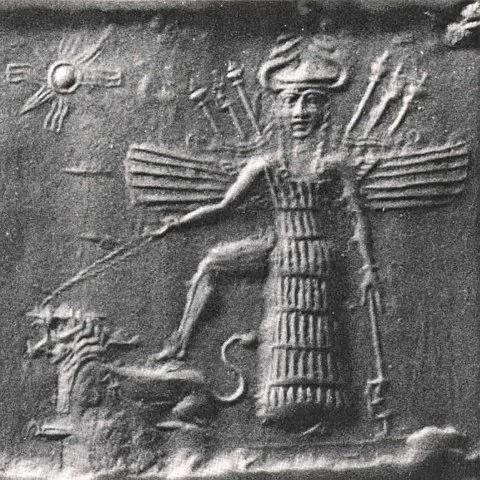
The most famous story about Inanna concerns her trip to the underworld (ruled by Inanna’s sister, the dark and jealous goddess Ereshkigal). One day Inanna left heaven. She abandoned her seven cities and emptied her temples. She donned the seven sacred objects symbolic of her queenhood and set out for the realm from which no traveler returns. Before leaving, however, Inanna left explicit directions with her faithful vassal, Ninshubur, concerning what to do if she (Inanna) did not return in three days.
Arrayed in splendor, Inanna came before the great bronze gate to the underworld and announced herself as “Inanna, Queen of Heaven.” She claimed to be visiting the underworld to attend her sister’s husband’s funeral. The doorkeeper of the dead, Neki was amazed and he sought Ereshkigal’s orders. To enter the underworld, Inanna had to give up her crown and, at each subsequent gate she was forced to part with another of her treasures/garments
The First Gate: Crown Chakra — The Crown of Authority
Inanna announces her descent to the Great Below, and her faithful servant Ninshubar begs her not to go. She goes anyway. At the first gate, the gatekeeper Neti demands she remove her crown, the lapis lazuli crown that marks her as sovereign of heaven. This is the Crown Chakra, the seat of divine connection, of knowing oneself as a child of the cosmos. To surrender it is to surrender the certainty that the universe organizes itself around your authority. This is the first and perhaps the hardest stripping, because it is the loss of the story we tell about who we are at the very top of our identity. Inanna asks why. The answer at every gate is the same: "Quiet, Inanna. The ways of the underworld are perfect. They may not be questioned." There is no negotiating with the initiatory process. The Crown must come off before anything real can begin.
The Second Gate: Third Eye — The Earrings of Perception and Sceptor
At the second gate, Inanna surrenders her earrings of spiritual vision and prophetic power, associated in this framework with the Third Eye Chakra, the seat of perception, intuition, and the stories we believe about what we see. In ordinary life, we are ruled by our interpretations. We see what we expect to see; we build entire inner worlds from the maps we've been handed. The scepter represents the power to define reality. To lay it down is to agree, at least temporarily, that you no longer know what anything means. The underworld does not operate according to the logic of the upper world. Surrendering this gate means entering a territory that cannot be decoded by prior frameworks — a place where the priestess, the therapist, the seer, and the strategist all fall silent.
The Third Gate: Throat Chakra — The Lapis Necklace of Voice
The lapis Necklace at Inanna's throat are removed at the third gate, and with them goes her voice — her capacity to name herself, to speak her truth, to declare her will into the world. The Throat Chakra governs authentic self-expression and carries particular weight for women who have been silenced, exiled, or labeled dangerous for speaking. The Inanna–Ereshkigal split is often read as the split between the "acceptable" woman and the one who says too much, feels too much, wants too much. To pass through this gate, Inanna must release the need to be heard, understood, or believed. She must move in silence into the place where language cannot follow.
The Fourth Gate: Heart Chakra — The Breastplate of Compassion
At the fourth gate, the breastplate covering Inanna's heart is removed. This is the middle gate, the fulcrum of the journey. The Heart Chakra is the bridge between the upper and lower centers, between heaven and earth, between mind and body. The breastplate is protection, the armoring we build after grief, betrayal, and loss. This gate asks us to approach what lies below not with fear but with an open and vulnerable heart. This is perhaps the most paradoxical demand of the entire descent: that we move toward the thing that most terrifies us while remaining completely undefended. Inanna does not harden herself. She opens herself. This is not weakness. It is the specific courage that the underworld requires.
The Fifth Gate: Solar Plexus, The Golden Belt of Personal Power
The golden rings of power come off at the fifth gate, corresponding to the Solar Plexus Chakra, the seat of will, ego integrity, personal agency, and self-worth. This is where we live most of our waking lives, managing and asserting and achieving. The Solar Plexus is the engine of the self in the world. To surrender it means relinquishing the belief that one can control outcomes, earn one's way through difficulty, or power through by force of personality. In the underworld, all of that is useless. The ego that has built a life through effort and identity must stand down. The ring of power, removed here, is not power itself, it is the performance of power, the compensatory self that formed around old wounds and called itself strength.
The Sixth Gate: Sacral Chakra — The Sacred Bracelets of Creativity and Innocence
At the sixth gate, the egg-shaped beads at Inanna's wrists are removed, the beads associated in this tradition with the Sacral Chakra, the seat of creativity, desire, pleasure, and erotic innocence. This is the gate of reclaiming the body's knowing, the pre-shame aliveness that was present before culture told us our desires were too much or not enough. The split between Inanna (light, sanctioned) and Ereshkigal (dark, exiled) is most vivid here: one sister has been elevated to heaven while the other, associated with the raw power of instinct and grief, has been banished underground. To pass through this gate fully, Inanna must begin to recognize that Ereshkigal's territory is not her opposite. It is her depth.
The Seventh Gate: Root Chakra — The Royal Robes of Manifestation
At the last gate, Inanna's royal robes fall away. She stands before Ereshkigal naked, with nothing. The Root Chakra is our sense of physical safety, belonging, and existence itself. The robes represent all external markers of who we are in the material world — rank, belonging, security, survival. Their removal is total. Inanna arrives in the underworld as pure essence, stripped of every layer that ever mediated between her and annihilation. And there, Ereshkigal turns the eye of death upon her. Inanna is killed. Her body is hung on a hook in the darkness for three days and three nights.
Death and the Pivot
The most important moment in the myth is not the descent. It is the waiting. There is a pause at the bottom that has no resolution in it, only darkness, silence, and the complete absence of the self that entered. This is the alchemical moment the tradition calls the Underworld Container. It cannot be rushed. It cannot be managed. It can only be endured by the parts of us that we left behind at the surface, while the thing that had to die, dies.
Meanwhile, above ground, Ninshubar carries out Inanna's instructions and cries for help at the threshold of every great deity. Most turn away. But Enki, the god of wisdom and waters, fashions two small mourning beings, creatures so small and nimble they can slip through the cracks of the underworld gates, and sends them down with the food and water of life. They find Ereshkigal in her own agony, mourning and moaning. And here the myth performs its most startling reversal: instead of demanding Inanna back, they simply sit with Ereshkigal. They witness her grief. They echo it back without judgment. And in response, Ereshkigal, softened, seen, releases Inanna.
The Ascent: Reclaiming the Gateways
The ascent reverses the descent gate by gate. At each threshold, Inanna reclaims what she surrendered — but she is not the same woman who laid these things down. The Root robe, the Sacral beads, the Solar ring, the Heart breastplate, the Throat necklace, the Third Eye earrings and scepter, the Crown headpiece — each is returned. The ascent is not a restoration to what was before. It is a coronation into authentic power. The woman who reclaims her crown after having hung naked in the dark has earned it in a different way. She no longer wears it because she was born to it. She wears it because she survived its absence.
This is what the myth ultimately illuminates: the difference between borrowed power and earned wholeness. The identities we carry into the descent, the roles, titles, voices, and certainties, are not false in themselves. But until they have been surrendered, we cannot know which of them are genuinely ours and which we clung to out of fear. The gateways are not punishments. They are questions, posed by the underworld, about what remains when everything is taken.
Inanna returns. But she does not return alone: the underworld claims a substitute, and the myth continues into its own complications. What endures, however, is the structural truth at the heart of the story — that the Queen of Heaven could not rule the whole of reality until she had visited the whole of reality. That she could not know the light without descending into the dark. That the descent, terrible as it was, was not her undoing. It was her completion.
Four thousand years later, we still recognize this pattern because we still live it, in grief, in illness, in creative collapse, in the long dark nights that strip us of the stories we told ourselves about who we were. Inanna's myth does not offer comfort in the easy sense. It offers something better: the assurance that what waits at the bottom of the spiral is not oblivion, but the self we were always becoming, waiting to be retrieved.
