Culture Emerged through the Feminine
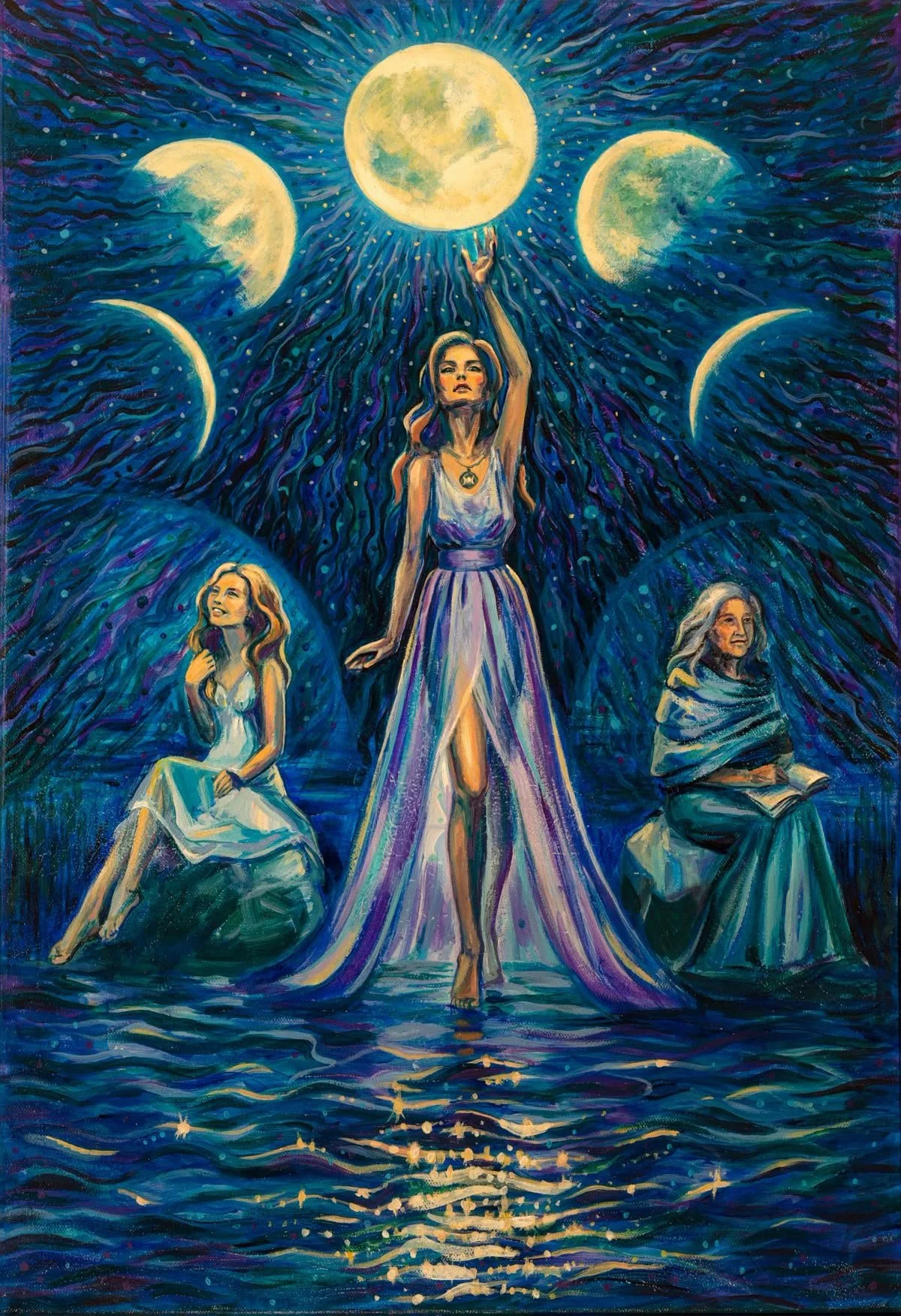
Art by Elena Avarina
In the Beginning, There Was the Mother
Before the city-state, before the alphabet, before the written law, the voice that sang a child into sleep, the memory that held the names of healing herbs and the stories of the dead. Long before history was recorded by those who would later claim to have invented civilization, women were civilization's quiet architects. To say that the feminine is, when examined with clear eyes, closer to fact than most of what we call history.
The oldest known sculptures in human existence are not warriors or kings. They are women, round, abundant, powerful women. The Venus of Willendorf. The Venus of Laussel, carved into rock with one hand raised, holding a lunar crescent. The Mother Goddess figurines scattered across the ancient Near East, across Anatolia, across the Mediterranean rim. They are theology. They were the first attempt by human consciousness to give shape to the sacred, and that shape was female.
What Culture Actually Is
We tend to think of culture as high art, literature, grand architecture, the monuments men built. But culture in its deeper, anthropological sense is the web of meaning by which a community holds itself together: the rituals that mark birth and death, the songs that transmit values across generations, the medicines that heal, the stories that explain why suffering exists and how one ought to endure it. Culture is the infrastructure of the human psyche.
And this infrastructure, almost universally, across every ancient society we have studied, was tended by women.
Women were the first farmers. A growing body of archaeological and ethnobotanical evidence suggests that it was women who domesticated plants, centuries of intimate observation of growth cycles, seed selection, soil, and season, made possible precisely because women's lives were more sedentary, more bound to the rhythms of place. Agriculture, the very foundation of civilized life, is almost certainly a feminine invention.
Women were the first healers. The knowledge of plants and their properties, the understanding of the body in its most vulnerable moments, childbirth, fever, wound, all of this belonged to women. The village healer, the midwife, the herbalist: these figures predate the physician by millennia, and they were doing real, effective work long before the medical establishment emerged to displace them.
Women were the first weavers, and weaving is not a small thing. Cloth is civilization. It is warmth, it is trade, it is identity, it is art. The loom, across cultures, became a cosmic metaphor: the Fates weave destiny; the goddess Neith weaves the world; Penelope weaves and unweaves time itself. Weaving is among the oldest technologies, and it was carried in women's hands. Women are the weavers of fates. The weavers of destiny. The Weavers of the World.
Women were the first storytellers. Around every fire, in every home, in every cradle, it was largely women who passed language forward, who embedded moral imagination, empathy, ancestral memory, and a sense of the sacred into the minds of children before those children ever encountered any formal system of education. The oral tradition, the most durable transmission system humanity has ever devised, was maintained by women in nearly every culture.
The Goddess and the Sacred Feminine
It was not merely practical labor that women contributed. It was the metaphysical framework through which early humanity understood existence itself.
In Mesopotamia, Inanna was queen of heaven and earth, goddess of love, war, justice, and transformation. Her descent into the underworld and return is one of the oldest written narratives in human history, and it encodes a profound wisdom about death, renewal, and the courage to face one's shadow. In Egypt, Isis gathered the scattered pieces of Osiris and resurrected him, she was the principle of regeneration, the great magician, the protector. In Greece, before the Olympian order, there was Gaia, who simply was, the ground of all being. In Hinduism, Shakti is not a goddess among many but the primal energy without which even Shiva, pure consciousness, cannot move.
What these traditions understood, and what has been systematically suppressed in the dominant narratives of the last several thousand years, is that the feminine is not merely one polarity among equals. In many cosmologies, it is primary. The Great Mother precedes the Father God historically and, many would argue, symbolically. She is the void from which form emerges, the womb of creation, the force that cycles through birth, death, and rebirth without apology.
The shift from goddess-centered to god-centered spirituality, which occurred across the ancient world in a compressed period roughly between 3000 and 1000 BCE, accompanying the rise of pastoral nomadic cultures, empire, and the consolidation of patriarchal social organization, was not simply a theological change. It was a civilizational reprogramming. The qualities associated with the feminine, receptivity, cyclical time, embodiment, interdependence, emotional truth, the wisdom of nature, were systematically devalued. The qualities associated with a particular vision of the masculine, linearity, conquest, transcendence of nature, individual heroism, the abstraction of spirit from matter, were elevated. And we have been living inside the consequences of that shift ever since.
The Wound We Are Living In
The suppression of the feminine principle, in theology, in governance, in culture, in psychology, has not been neutral. It has consequences we can now measure.
An economy organized entirely around growth and extraction, with no concept of limit or care, is a masculine economy without its feminine counterpart. A relationship to the natural world organized around domination and resource consumption, rather than reciprocity and regeneration, reflects the same imbalance. A political order built on hierarchy, force, and the zero-sum logic of power at the expense of cooperation, relationship, and the long view — this is what happens when one half of the human inheritance is systematically denied.
We are living inside a planetary crisis that is, at its root, a crisis of values. And the values we are missing, care, cyclicality, embeddedness in nature, the priority of relationship over transaction, the wisdom to work with living systems rather than against them, are the values associated with the feminine, the values that lived at the center of the oldest human cultures, the values the goddess traditions were designed to transmit and protect.
This is not an argument for the supremacy of women over men. It is an argument for integration. The masculine and the feminine, within individuals, within cultures, within institutions, need each other to function fully. A culture that has suppressed one for three thousand years does not need simply to balance the scales. It needs to consciously remember, recover, and restore what was lost.
Why Now
We live in a time of simultaneous crisis and threshold. Climate collapse, democratic erosion, epidemic loneliness, mental health catastrophe, the unraveling of shared meaning, these are not separate problems with separate technical solutions. They are symptoms of a single, deep dis-ease: a civilization that has lost its feminine roots.
The goddess traditions, across all their cultural variations, shared certain wisdoms that are precisely what this moment demands. They understood time as cyclical, not merely linear: that what dies becomes the compost for what is born, that sustainability requires honoring the fallow season, not just the harvest. They understood the human being as embedded in the web of life, not separate from or superior to it. They understood the body, its pleasures, its cycles, its vulnerability, as sacred rather than shameful. They understood community as held by care rather than enforced by law. They understood the darkness, the grief, the descent, as initiatory rather than pathological.
Inanna descends into the underworld not as a victim but as someone willing to face the fullest truth of existence. She loses everything, her power, her garments, her status, and dies, and is reborn. This is not a comfortable story. But it is the story we may need most right now, as a civilization being asked to release attachments that are killing us, to descend into real reckoning with what we have done and who we have been, before we can emerge into something genuinely new.
The return of the feminine is not a political slogan or a marketing category. It is a civilizational imperative. It means recovering the intelligence of care. It means redesigning economies around regeneration rather than extraction. It means honoring the body and the earth as sacred, not as resources. It means restoring the voice of those who have always known how to tend life, women, indigenous peoples, the wisdom traditions that were pushed to the margins when the conquering order declared itself the whole story.
Remembering as Revolutionary Act
To remember that the feminine created culture is, in this cultural moment, an act of profound resistance. It is an act of rebelillion. It is to insist on a different story about what human beings are and what civilization can be. It is to recover ancestors, not biological ancestors necessarily, but ancestral wisdom: the weaver, the healer, the storyteller, the one who stands at the threshold of birth and death and knows what to do.
This remembering is not nostalgia. We are not called to return to some prelapsarian paradise. We are called to bring the forgotten half of our inheritance forward into the complexity of now, to weave the old wisdom into new forms, to honor what was suppressed without romanticizing it, to let the goddess teach us not as a relic but as a living intelligence that never fully disappeared, only went underground.
She is still here, in every act of genuine care, every choice to protect the living world, every refusal to treat people as means rather than ends, every willingness to sit with grief rather than rush past it, every community that chooses cooperation over competition, every healer, every artist, every mother and every man who has learned to tend.
The culture the feminine created, and sustained, quietly, beneath the noise of empire, is the culture that made us human. It is the culture we will need to make us wise enough to survive what is coming.
It is time to remember.
"The world will be saved by the Western woman." — attributed to the Dalai Lama, 2009
"No culture can survive if it attempts to be exclusive." — Mahatma Gandhi
